
UNDERSTANDING GLP-1, and the Hormones That Control Appetite
From Hunger to Fullness
Your appetite is not simply a matter of willpower
Have you ever wondered why you can feel completely satisfied after one meal, yet feel intensely hungry a few hours later? Or why dieting can sometimes make hunger seem stronger rather than weaker?
The answer lies partly in a sophisticated communication system between your digestive system, pancreas, fat tissue and brain.
Your body is constantly monitoring what you eat, how much energy is available, how much food is in your stomach and intestines, and whether energy stores need to be replenished. Hormones and nerve signals communicate this information to the brain, influencing hunger, fullness, meal size, food choices and energy balance.
This communication system is often referred to as the gut–brain axis.
Understanding it helps explain why GLP-1 medications can have such a powerful effect on appetite and body weight. But to understand GLP-1 medication, we first need to understand the natural hormones that regulate eating.
The gut and brain are constantly communicating
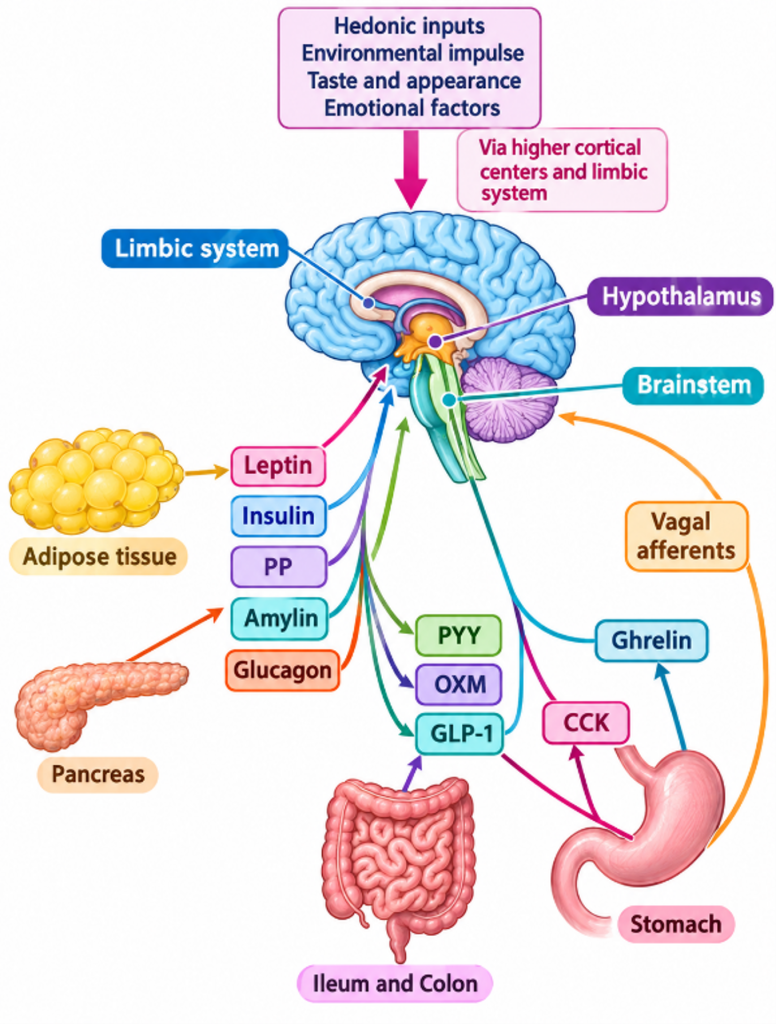
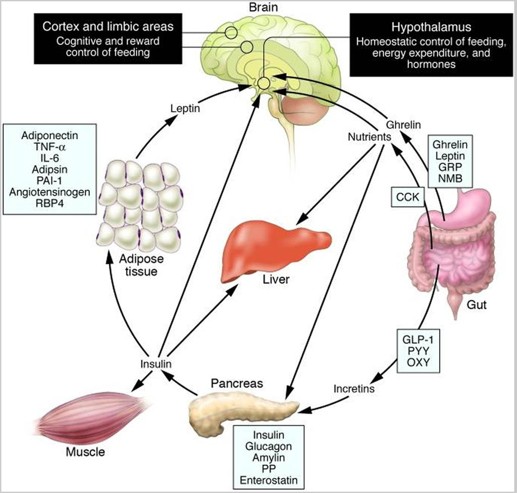
As soon as food enters your mouth, sensory information about its taste, texture and palatability is communicated to the brain. As food moves through the digestive tract, the stomach and intestines detect its volume and nutrient content. Hormones are released and nerve signals travel between the digestive system and brain.
Two major communication routes are involved:
Hormonal communication: Hormones released from the digestive tract and pancreas can travel through the bloodstream and act on different organs, including the brain.
Nerve communication: The vagus nerve acts like a communication highway between the digestive tract and the brain. Stretch receptors in the stomach, for example, detect that the stomach is filling and send signals towards the brainstem.
Together, these systems continually answer questions such as:
- Am I hungry?
- How much food is coming in?
- Do I have enough energy available?
- Should I continue eating?
- Should I stop eating now?
Several hormones play particularly important roles in this conversation.
Ghrelin — the “hunger hormone”
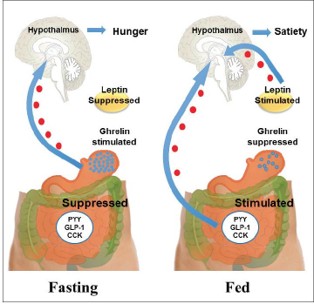
Ghrelin is produced primarily in the stomach, and its levels generally rise during fasting and when we are hungry.
Its basic message is: “Energy is becoming less readily available. It is time to eat.”
Ghrelin acts on areas of the brain involved in appetite and motivation, including the arcuate nucleus (ARC) of the hypothalamus. It can also influence reward pathways, increasing the motivation to obtain highly palatable foods.
This means hunger is not simply about needing calories. The brain’s reward system also influences how motivated we feel to find and eat food.
Why can dieting make hunger worse?
During weight loss, circulating ghrelin can increase, contributing to increased hunger during and after diet-induced weight loss.
This helps explain why maintaining weight loss can be difficult. It is not necessarily a lack of motivation or willpower; the body has powerful biological mechanisms designed to defend energy balance.
CCK — the “slow down” signal
Once you begin eating, the signals start to change.
CCK, or cholecystokinin, is released by specialised cells in the intestine in response to nutrients. It acts strongly through receptors associated with the vagus nerve, sending information towards the brain.
Its message is essentially: “Food has arrived. Start reducing the drive to eat.”
CCK also helps slow gastric emptying. As food remains in the stomach, stomach distension provides another signal of fullness.
This demonstrates that fullness is created by several signals working together.
The physical stretching of the stomach, CCK, GLP-1, PYY and other signals accumulate as the meal progresses, eventually contributing to meal termination.
GLP-1 — a powerful multitasker
Now we come to GLP-1: glucagon-like peptide-1.
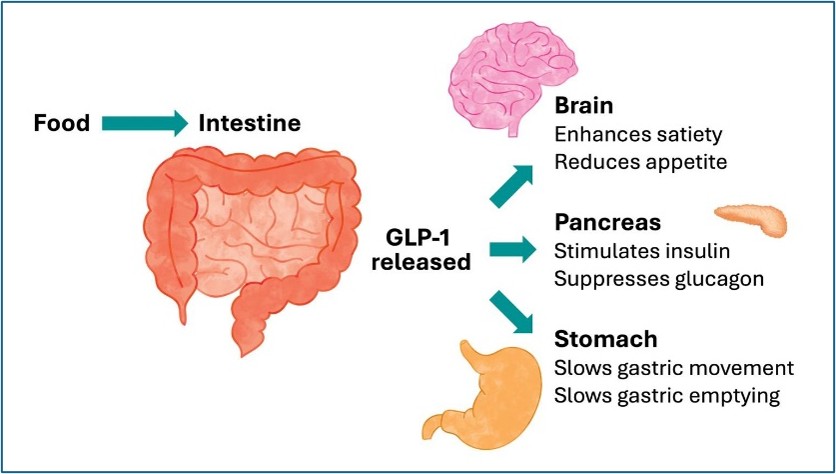
GLP-1 has received enormous attention because of GLP-1-based medications. However, it is not something created by medicine — your body naturally produces it after eating. It is released from specialised L-cells in the distal small intestine and large intestine in response to nutrients. Naturally produced GLP-1 is rapidly broken down and has a very short half-life.
GLP-1 performs several important functions.
- Blood glucose regulation: GLP-1 is an incretin hormone. After eating, it helps stimulate insulin secretion in a glucose-dependent manner and suppresses glucagon. This helps the body manage the rise in blood glucose following a meal.
- Slowing gastric emptying: GLP-1 also slows the movement of food from the stomach into the intestine. This can help prolong feelings of fullness and influence the rate at which nutrients become available.
- Appetite regulation: GLP-1 communicates with the nervous system involved in appetite regulation. It can influence pathways involving the vagus nerve and brain and also interacts with areas involved in food reward and motivation.
So GLP-1 is much more than a “fullness hormone”. It participates in the coordination of:
food intake + gastric emptying + insulin + glucagon + blood glucose + appetite
PYY — another fullness signal
PYY, or peptide YY, is another hormone released after eating.
It is produced by intestinal L-cells and can be released alongside GLP-1. PYY levels rise during and after a meal, with the amount released influenced by the energy and macronutrient content of the meal.
PYY contributes to the growing signal that tells the brain: “The meal is progressing. You are becoming satisfied.”
It can also slow gastric emptying, helping increase the time available for satiety signals to develop.
GLP-1 and PYY therefore form part of an accumulating negative-feedback system that helps bring a meal to an end.
Insulin — more than a blood-sugar hormone
Most people know insulin for its role in controlling blood glucose, but it also communicates with the brain
Produced by the β-cells of the pancreas, insulin helps move glucose from the bloodstream into cells and assists with energy storage and utilisation.
Insulin receptors are found in areas involved in appetite regulation, including the hypothalamus, and signalling can influence food intake and reward-related processes.
The pancreas therefore does more than regulate blood glucose. It also communicates information about the body’s nutritional state.
Amylin — insulin’s partner
Amylin, also known as islet amyloid polypeptide (IAPP), is produced by pancreatic β-cells and released alongside insulin after eating.
Amylin complements some of insulin’s effects. It can:
- slow gastric emptying
- suppress glucagon release
- reduce food intake
- contribute to satiation
- influence appetite through receptors in the brain.
The pancreas is therefore an important part of the larger gut–pancreas–brain communication network.
Imagine you have not eaten for several hours.
BEFORE THE MEAL
Ghrelin rises, increasing hunger and motivation to find food.
↓
YOU START EATING
Taste, smell and texture provide sensory information to the brain.
↓
FOOD ENTERS THE STOMACH
The stomach stretches and the vagus nerve communicates this information to the brain.
↓
NUTRIENTS ENTER THE INTESTINE
CCK, GLP-1 and PYY increase.
↓
These signals contribute to slower gastric emptying and increasing satiation.
↓
THE PANCREAS RESPONDS
GLP-1 promotes glucose-dependent insulin secretion, while amylin is released alongside insulin and glucagon is suppressed.
↓
THE BRAIN INTEGRATES THE SIGNALS
The brain combines information from stomach distension, gut hormones, pancreatic hormones, nutrient availability and reward pathways.
↓
EVENTUALLY…
The combined signals contribute to:
“I’ve had enough.”
The meal ends.
Satiation versus satiety
Both are important in regulating overall food intake but are often confused.
Satiation answers: “Have I had enough?” It is what helps you stop eating during a meal. CCK, GLP-1, PYY, stomach distension and other signals contribute to this process.
Satiety answers: “How long can I go before I want to eat again?”. It is what helps keep you from wanting to eat again soon after a meal.
Why can weight loss be so difficult?
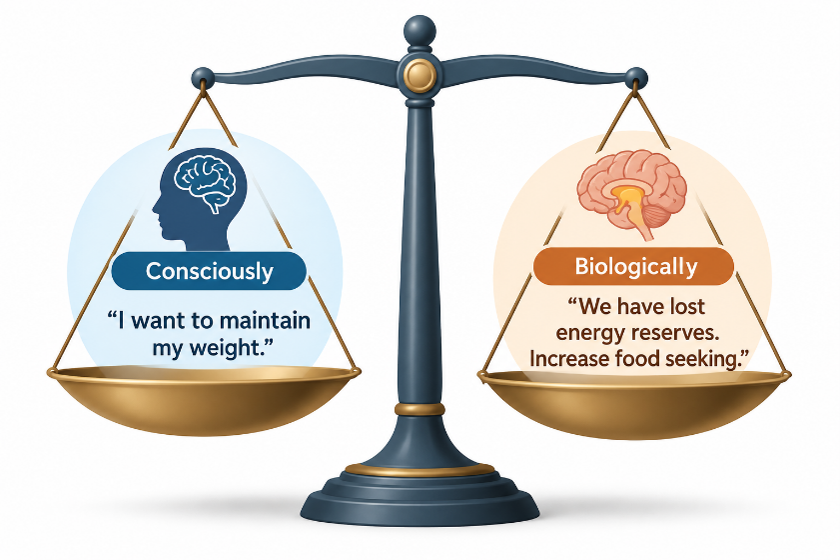
The appetite-regulation system is highly adaptable. When body weight decreases, the body may respond by increasing hunger and food-seeking signals. Ghrelin, for example, can increase during and after diet-induced weight loss, while, at the same time, some satiety signals may not increase enough to compensate.
Understanding this helps explain why long-term weight management can be challenging and why obesity should not simply be viewed as a matter of willpower.
So where do GLP-1 medications fit in?
Now the role of GLP-1 medication becomes much easier to understand.
GLP-1 medications act on a system that already exists naturally in the body. The major difference is duration.
Naturally produced GLP-1 is rapidly broken down. GLP-1-based medicines are designed to produce much longer-lasting activation of the GLP-1 receptor.
Natural GLP-1
A meal arrives → GLP-1 is released → it helps coordinate the response → the signal is rapidly broken down.
GLP-1 medication
Medication → prolonged GLP-1 receptor activation → sustained physiological effects.
This can result in:
- ↓ appetite
- ↓ food intake
- ↑ feelings of fullness
- ↓ gastric emptying
- ↑ glucose-dependent insulin secretion
- ↓ glucagon
This helps explain why GLP-1 receptor agonists can be effective in the management of type 2 diabetes and obesity.
Why might someone taking a GLP-1 medication say, “I’m just not hungry”?
The medication is not simply switching hunger off. Instead, prolonged GLP-1 receptor activation can influence several components of the appetite-control system.
- Increased satiation: A person may feel satisfied sooner.
- Reduced appetite: The drive to eat may decrease.
- Slower gastric emptying: Food remains in the stomach longer, contributing to fullness.
- Changes in food reward: GLP-1 signalling can influence pathways involved in the motivation to seek highly palatable foods.
- Improved glucose regulation: GLP-1 helps coordinate insulin and glucagon responses after eating.
And this is where nutrition still matters
GLP-1 medication can influence powerful biological pathways, but it does not change the body’s fundamental nutritional requirements.
Your body still needs protein to maintain muscle and repair tissues, fibre to support digestive health and satiety, vitamins and minerals for countless physiological processes, and appropriate amounts of carbohydrates, fats and protein to provide energy and support normal metabolism.
When appetite is reduced, it can become easier to eat less food without necessarily getting enough nutrition, and this makes food quality particularly important.
The goal should not simply be: “How little can I eat?” but rather: “How can I make the food I do eat as nourishing as possible?”
For sustainable health, the goal is not merely to eat less. It is to nourish the body well, whatever appetite-regulating tools are being used.
References
- Cummings, D.E., Purnell, J.Q., Frayo, R.S., Schmidova, K., Wisse, B.E. & Weigle, D.S. (2001). A preprandial rise in plasma ghrelin levels suggests a role in meal initiation in humans. Diabetes, 50(8), 1714–1719. https://doi.org/10.2337/diabetes.50.8.1714
- Cummings, D.E., Weigle, D.S., Frayo, R.S., Breen, P.A., Ma, M.K., Dellinger, E.P. & Purnell, J.Q. (2002). Plasma ghrelin levels after diet-induced weight loss or gastric bypass surgery. New England Journal of Medicine, 346(21), 1623–1630. https://doi.org/10.1056/NEJMoa012908
- Cummings, D.E. & Shannon, M.H. (2003). Roles for ghrelin in the regulation of appetite and body weight. Archives of Surgery, 138(4), 389–396. https://doi.org/10.1001/archsurg.138.4.389
- Hayes, M.R., Mietlicki-Baase, E.G., Kanoski, S.E. & De Jonghe, B.C. (2014). Incretins and amylin: Neuroendocrine communication between the gut, pancreas, and brain in control of food intake and blood glucose. Annual Review of Nutrition, 34, 237–260. https://doi.org/10.1146/annurev-nutr-071812-161201
- Holst, J.J. (2007). The physiology of glucagon-like peptide 1. Physiological Reviews, 87(4), 1409–1439. https://doi.org/10.1152/physrev.00034.2006
- Kojima, M., Hosoda, H., Date, Y., Nakazato, M., Matsuo, H. & Kangawa, K. (1999). Ghrelin is a growth-hormone-releasing acylated peptide from stomach. Nature, 402, 656–660. https://doi.org/10.1038/45230
- Murphy, K.G. & Bloom, S.R. (2006). Gut hormones and the regulation of energy homeostasis. Nature, 444, 854–859. https://doi.org/10.1038/nature05484
- Näslund, E., Bogefors, J., Skogar, S., Grybäck, P., Jacobsson, H., Holst, J.J. & Hellström, P.M. (1999). GLP-1 slows solid gastric emptying and inhibits insulin, glucagon, and PYY release in humans. American Journal of Physiology-Regulatory, Integrative and Comparative Physiology, 277(3), R910–R916. https://doi.org/10.1152/ajpregu.1999.277.3.R910
- Schwartz, M.W., Woods, S.C., Porte, D. Jr., Seeley, R.J. & Baskin, D.G. (2000). Central nervous system control of food intake. Nature, 404, 661–671. https://doi.org/10.1038/35007534
- Strader, A.D. & Woods, S.C. (2005). Gastrointestinal hormones and food intake. Gastroenterology, 128(1), 175–191. https://doi.org/10.1053/j.gastro.2004.10.043